


Connect Muse to Apify
Connect Muse to Apify in 3 steps: 1. Sign in to ApexGenius and connect Apify. 2. Add the ApexGenius connector. 3. Start using Apify in Muse.
1,000 free credits · No card required
How to connect Apify to Muse
- 1Sign in to ApexGenius and connect Apify
- 2Add the ApexGenius connector to Muse
- 3Start using Apify in Muse
- 1
Connect Apify to ApexGenius
Connect Apify
Apify opens its own sign-in. Sign in and allow ApexGenius.
- 2
Connect ApexGenius to Muse
Choose Muse
Back on Start, pick Muse and copy the prompt.
- 3
Add it in Muse
In Muse, ask it to connect ApexGenius. Choose Connect on the card.
- 4
Approve access
ApexGenius opens its approval page. Review the access, then approve.
Add the ApexGenius connector to Muse
Muse adds ApexGenius as a custom connector from inside a chat. There is no config file and no terminal step.
- In ApexGenius, pick Muse on Start and copy the Muse setup prompt.
- In Muse, ask it to connect ApexGenius and paste the prompt. Muse shows an ApexGenius connector card. Choose Connect.
- Sign in to ApexGenius in your browser and approve access.
The MCP address
https://server.autom8.pro/mcp
Check it. Ask Muse which apps are connected. The setup prompt tells it to call apex_search_tools with an empty query and list them.
Then ask Muse
Search Apify Store for an Actor that scrapes Google Maps reviews and show its price. Do not run any Actor or spend credits.
Written setup, step by stepShow
Before you start
- An account with permission to use the Apify resources you intend to connect.
1. Connect Apify to ApexGenius
- Open Apify in Connections. Choose Connect, or Add connection when offered. Give the connection a name if prompted. If Gateway setup pending appears, contact ApexGenius support before continuing.
- Choose the account and review access. Sign in to Apify in the browser and approve access for ApexGenius. Apify uses browser authorization; no Apify API token is pasted into ApexGenius.
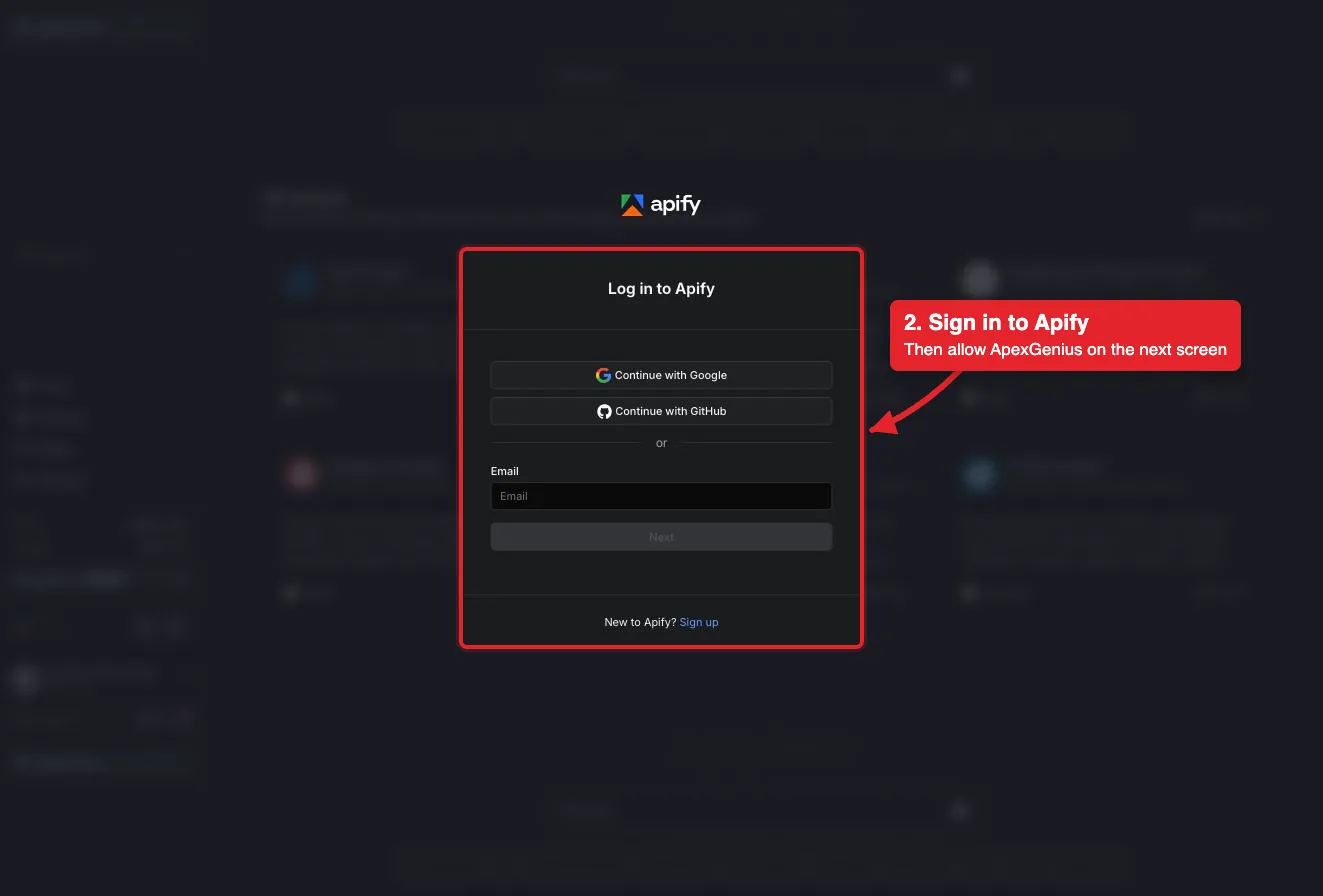
Connect opens Apify's own sign-in. Sign in with Google, GitHub or email, then allow ApexGenius.Open full-size image (opens in a new tab) - Review the connected account and resources. Confirm the connected Apify account. Open Tools to review the Apify tools. Running an Actor spends Apify credits on that account, and a run keeps going until it finishes or is stopped.
- Check the connection. Use Test connection or Check again and read the reported status. Add an AI agent from the AI agents page, choose Read only for the first test, and try the question below.
2. Connect ApexGenius to Muse
Use this server address when adding the connection:
https://server.autom8.pro/mcpThe steps are above, under Add the ApexGenius connector to Muse. These notes apply to Muse only.
- Why the prompt is long. Muse’s custom connector asks for the sign-in addresses up front instead of reading them from the MCP address. The Muse setup prompt carries the authorize, token and registration addresses. No client ID or secret is needed.
- Access. When ApexGenius asks what Muse may use, choose Read only for the first test, or Custom to limit it to the tools you need.
3. Verify one safe read
Search Apify Store for an Actor that scrapes Google Maps reviews and show its price. Do not run any Actor or spend credits.
Search Apify Store for an Actor that scrapes Google Maps reviews and show its price. Do not run any Actor or spend credits.Compare the returned account and resource with Apify. Check the connection status separately from the result of the first read.
Full guide: the Apify setup guide.
What it looks like in Muse
Illustration of a task, not a recorded customer result. Your answers come from the account and dates you choose.
apex_search_toolsApify Store search · Find the Apify read routeCompleteapex_call_read_toolsearch-actors · Search Apify StoreCompleteapex_call_read_toolfetch-actor-details · Read the Actor’s input and priceCompleteIllustrative example: the top match is a Google Maps reviews scraper that charges per result. Its input takes place URLs and a maximum number of reviews. Nothing was run and no credits were spent.
Read-only routeWhat to ask Muse about Apify
- Find an Actor
Search Apify Store for an Actor that scrapes Google Maps reviews and show its price. Do not run anything.
Runs
search-actors(read), thenfetch-actor-details(read). - Check a run
Show the status of this Apify run and where its results are stored.
Runs
get-actor-run(read). - Read results
Read the first 20 results from the dataset of this run, with only the title and URL fields.
Runs
get-actor-run(read), thenget-dataset-items(read).
These 3 questions use 4 of Apify’s 11 operations. The full list is below.
- Run the Website Content Crawler on this one URL. Show me the input and the price first. (write)
- Stop the run I just started and tell me what it produced so far. (write)
What Muse can do in Apify
11 operations: 7 read, 4 write. Read looks things up and changes nothing. Writes change Apify and run only when you turn them on.
Find an Actor
2 readsearch-actorsreadSearch Apify Store for Actors by keyword. Starts no run.
fetch-actor-detailsreadRead one Actor’s input schema, output, README and price.
Run an Actor
3 writecall-actorwriteRun any Actor with your input. Waits up to 45 seconds, then returns the run status and storage IDs.
apify--rag-web-browserwriteRun the RAG Web Browser Actor: search the web and read the top pages.
apify--web-fetchwriteRun the Web Fetch Actor: fetch one URL and return its content.
Runs and results
3 readget-actor-runreadRead one run’s status and storage IDs.
get-dataset-itemsreadRead a run’s results from its dataset, with limit, offset and field filters.
get-key-value-store-recordreadRead one saved record, such as OUTPUT, from a key-value store.
Stop a run
1 writeabort-actor-runwriteStop a run. A stopped run cannot be resumed, and credits already spent are not refunded.
Apify documentation
2 readsearch-apify-docsreadSearch the Apify documentation.
fetch-apify-docsreadRead one Apify documentation page by its URL.
You choose the access. When you approve Muse, pick Full access, Read only, or Custom.
One connection is one Apify account. Apify grants full API access to that account; ApexGenius tool controls limit what your AI can call.
Reads go through a read-only route that checks Apify’s live labels. Running an Actor spends Apify credits, and runs and stops happen right away when enabled.
ApexGenius loads Apify’s default tool set. Run lists, run logs, storage lists, saved tasks, schedules and builds are not included.
Disconnecting stops future access. It does not stop a run that is already going, refund credits, or delete results.
Questions about connecting Muse to Apify
Updated November 12, 2026.
How do I connect Muse to Apify?
Sign in to ApexGenius and connect Apify. In Muse, ask it to connect ApexGenius, paste the Muse setup prompt from ApexGenius, and choose Connect on the connector card. Then ask Muse: “Search Apify Store for an Actor that scrapes Google Maps reviews and show its price. Do not run any Actor or spend credits.” Start with a read, so nothing changes.
How do I check that Muse can use Apify?
Ask Muse which apps are connected through ApexGenius. It calls apex_search_tools and lists them, and Apify should be there. If Muse shows the ApexGenius connector card again, choose Connect and finish the browser sign-in. Then ask: “Search Apify Store for an Actor that scrapes Google Maps reviews and show its price. Do not run any Actor or spend credits.”
Does running an Actor cost money?
Yes. Actor runs spend Apify credits on your account. Some Actors charge per result or event, others for the compute they use, and reading results can use a little platform usage. Your AI can read an Actor’s price before it runs anything.
How do I stop a run?
Ask your AI to stop it. It calls abort-actor-run with the run ID. You can also open the run in Apify Console and choose Abort. A stopped run cannot be resumed.
Can I undo a run?
No. Credits already spent are not refunded, and anything an Actor fetched or sent to other sites cannot be taken back. Results stay in your Apify account until you delete them in Apify Console.
Which Apify tools are included?
Apify’s default hosted set: Store search, Actor details, running an Actor, the RAG Web Browser and Web Fetch Actors, run status, results, stopping a run, and Apify docs. Run lists, logs, schedules and saved tasks are not included.
More connections like this one
Muse with other apps
 n8n
 Supabase
 Mobbin
 Cal.com
 Slack
 Discord
 ChatGPT Ads
 GitHub
All 48 apps Muse can use
 Stripe
 Context.dev
 Attio
 Semrush
 Notion
 Linear
 Jira
 HQ Rental
 Google Ads
 Google Analytics
 Google Forms
 Google Meet
 Google Tasks
 Gmail
 Google Calendar
 Google Chat
 Google Docs
 Google Drive
 Google Sheets
 Google Slides
 Apollo
 Blotato
 Bing Webmaster
 Calendly
 ClickUp
 monday.com
 Atlassian Rovo
 Polymarket
 OP.GG
 YouTube
- YouTube Analytics
 Salesforce
 Confluence
 Google Search Console
 ElevenLabs
 FreshBooks
 Trello
 GitLab
 TypeSafe
 HubSpot
Other agents with Apify
 Claude
 Grok Bot
Connect Apify to Muse today
Start free1,000 free credits. No card required. Disconnect any time.