


Connect ChatGPT to Attio
Connect ChatGPT to Attio in 3 steps: 1. Sign in to ApexGenius and connect Attio. 2. Add the ApexGenius plugin. 3. Start using Attio in ChatGPT.
1,000 free credits · No card required
How to connect Attio to ChatGPT
- 1Sign in to ApexGenius and connect Attio
- 2Add the ApexGenius plugin to ChatGPT
- 3Start using Attio in ChatGPT
- 1
Connect Attio to ApexGenius
Connect Attio
Attio opens its own sign-in. Sign in and allow ApexGenius.
- 2
Connect ApexGenius to ChatGPT
Choose ChatGPT
Back on Start, pick ChatGPT and copy the prompt.
- 3
Add it in ChatGPT
In ChatGPT, open Settings, then Plugins, then Create. Paste the address, keep OAuth.
- 4
Approve access
ApexGenius opens its approval page. Review the access, then approve.
Add the ApexGenius plugin to ChatGPT
ChatGPT adds a custom MCP server as a plugin, under Plugins. There is no config file.
- Go to ChatGPT Plugins, select the plus button, then Add custom MCP server.
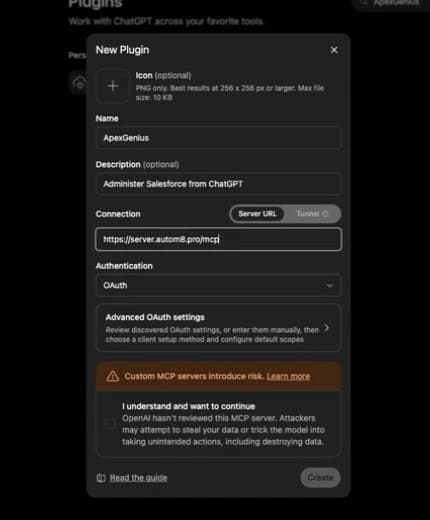
- Enter the name ApexGenius and a description. Under Connection, enter the MCP address, including the
/mcppath. - Configure authentication, review the risk warning and select I understand and want to continue. Select Create as a plugin.
- Complete the ApexGenius sign-in, approve access, and review the tools ChatGPT found.
The MCP address
https://server.autom8.pro/mcp
Check it. Start a new conversation, type @ in the prompt box and select the ApexGenius plugin.
Steps follow OpenAI Developers, Connect and test your plugin (opens in a new tab), read November 12, 2026.
Then ask ChatGPT
Use whoami to show which Attio user and workspace are connected, then list the lists in my workspace. Do not change anything.
Written setup, step by stepShow
Before you start
- An account with permission to use the Attio resources you intend to connect.
- ChatGPT developer mode must be available to your account and allowed by your workspace.
1. Connect Attio to ApexGenius
- Open Attio in Connections. Choose Connect, or Add connection when offered. Give the connection a name if prompted. If Gateway setup pending appears, contact ApexGenius support before continuing.
- Choose the account and review access. Sign in to Attio in the browser, choose the workspace, and allow access. Attio uses browser authorization; no API key is pasted into ApexGenius.
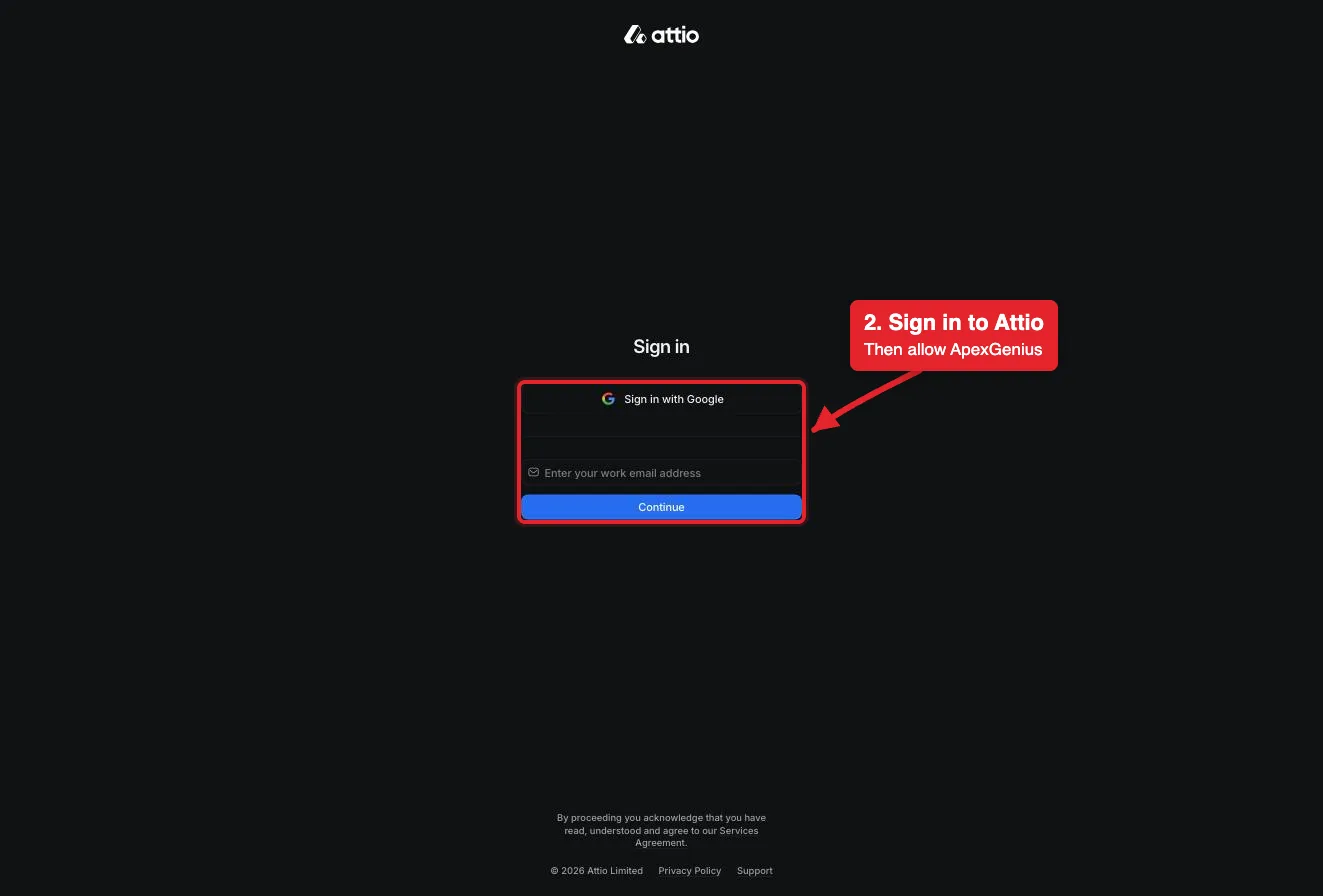
Connect opens Attio's sign-in. Sign in with Google or your work email, then allow ApexGenius.Open full-size image (opens in a new tab) - Review the connected account and resources. Confirm the connected Attio user and workspace. Open Tools to review the record, list, note and task actions. Your Attio permissions set what the connection can reach.
- Check the connection. Use Test connection or Check again and read the reported status. Add an AI agent from the AI agents page, choose Read only for the first test, and try the question below.
2. Connect ApexGenius to ChatGPT
Use this server address when adding the connection:
https://server.autom8.pro/mcpThe steps are above, under Add the ApexGenius plugin to ChatGPT. These notes apply to ChatGPT only.
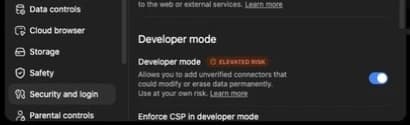
- If Add custom MCP server is missing. Account and workspace policies apply to custom MCP servers. Where ChatGPT offers Developer mode, turn it on under Settings, then Security and login. It has to be available to your account and allowed by your workspace.
- After ApexGenius adds tools. Open the connection at ChatGPT Plugins and select Refresh, then start a new conversation.
- Access. When ApexGenius asks what ChatGPT may use, choose Read only for the first test, or Custom to limit it to the tools you need.
Read the steps Follow along at your own pace
1. Enable developer mode
2. Create the plugin
3. Find ApexGenius
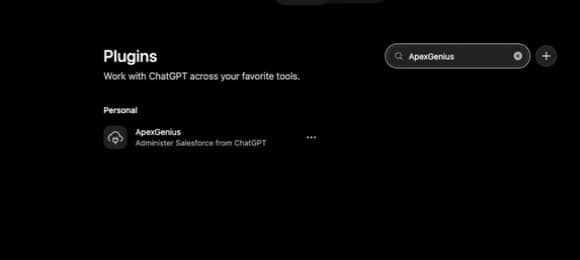
4. Review the connection
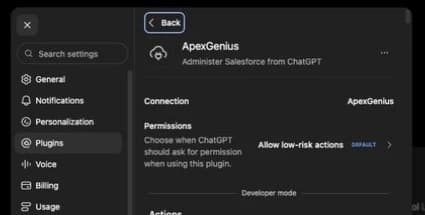
3. Verify one safe read
Use whoami to show which Attio user and workspace are connected, then list the lists in my workspace. Do not change anything.
Use whoami to show which Attio user and workspace are connected, then list the lists in my workspace. Do not change anything.Compare the returned account and resource with Attio. Check the connection status separately from the result of the first read.
Full guide: the Attio setup guide.
What it looks like in ChatGPT Work
Illustration of a task, not a recorded customer result. Your answers come from the account and dates you choose.

apex_search_toolsAttio workspace · Find the Attio read routeCompleteapex_call_read_toolwhoami · Read the connected userCompleteIllustrative example: the connected user is Alex in the Northwind workspace. Compare this with the Attio account you authorized before reading records. Nothing was changed.
Read-only routeWhat to ask ChatGPT about Attio
- Check the account
Who am I in Attio, and which workspace is connected? Do not change anything.
Runs
whoami(read). - Find contacts
Find every contact at Acme in Attio and show their titles and emails.
Runs
search-records(read), thenget-records-by-ids(read). - Pipeline by stage
Count open deals by stage in Attio. Do not change anything.
Runs
list-attribute-definitions(read), thenrun-basic-report(read).
These 3 questions use 5 of Attio’s 41 operations. The full list is below.
- Log a note on the Acme company record that sums up today's call. Show me the note first. (write)
What ChatGPT can do in Attio
41 operations: 26 read, 15 write. Read looks things up and changes nothing. Writes change Attio and run only when you turn them on.
Records and objects
5 read · 4 writelist-objectsreadList the objects in the workspace, such as companies, people and deals.
search-recordsreadFull-text search for records by name, email, domain or other indexed fields.
list-recordsreadList records in one object with filters and sorting.
get-records-by-idsreadRead full details for specific records by ID.
list-attribute-definitionsreadList the fields on an object, with their types and valid options.
create-recordwriteCreate a person, company, deal or custom object record.
upsert-recordwriteCreate or update a record that matches on a field such as email or domain.
update-recordwriteUpdate an existing record by its ID.
merge-recordswriteMerge two records of the same object into one. The primary record wins. Cannot be undone here.
Lists and pipelines
3 read · 5 writelist-listsreadList the lists in the workspace, filtered by name or slug.
list-list-attribute-definitionsreadList the entry fields on one list, with their types and options.
list-records-in-listreadList the entries in one list with filters and sorting, including their records.
create-listwriteCreate a list for records of one object type.
add-record-to-listwriteAdd a record to a list as a new entry.
update-listwriteChange a list's name, slug or permissions.
update-list-entry-by-idwriteUpdate a list entry when you know its entry ID.
update-list-entry-by-record-idwriteUpdate the one entry a record has in a list, found by the record ID.
Notes
3 read · 2 writesearch-notes-by-metadatareadFind notes by record, author, meeting or creation time.
semantic-search-notesreadFind notes by topic with AI search.
get-note-bodyreadRead the full text of one note.
create-notewriteCreate a note on a record.
update-notewriteAppend or prepend text to a note, or change its title.
Tasks
1 read · 2 writelist-tasksreadList tasks with filters, such as incomplete tasks due this week.
create-taskwriteCreate a task with a deadline, assignee and linked record.
update-taskwriteChange a task's deadline, status, assignee or linked record.
Comments
2 read · 2 writelist-commentsreadList comments on a record or list entry, with replies.
list-comment-repliesreadLoad more replies in one comment thread.
create-commentwriteComment on a record or list entry, or reply in a thread.
delete-commentwriteDelete a comment you created, with every reply under it.
Meetings and calls
4 readsearch-meetingsreadFind past and upcoming meetings by people, records or time.
search-call-recordings-by-metadatareadFind call recordings by people, records, title or time.
semantic-search-call-recordingsreadFind call recordings by topic with AI search.
get-call-recordingreadRead one call recording with its transcript.
Emails
3 readsearch-emails-by-metadatareadFind emails by people, domain or time.
semantic-search-emailsreadFind emails by topic with AI search.
get-email-contentreadRead the full body of one email.
Workspace
3 readwhoamireadRead the connected user and their workspace access. Start here.
list-workspace-membersreadList workspace members and their teams.
list-workspace-teamsreadList the teams in the workspace.
Reports and SQL
2 readrun-basic-reportreadCount, sum or average records or list entries, grouped as you choose.
query-particle-sqlreadRun a read-only SQL query on workspace data. Not on every Attio plan.
You choose the access. When you approve ChatGPT, pick Full access, Read only, or Custom.
The connection acts as the Attio user who signed in. Attio permissions set what it can reach; ApexGenius does not add a record-level allowlist.
The read route checks Attio's live tool labels and rejects writes or unlabeled operations.
Writes run immediately. Blocked hides a tool from agents.
Merges and deleted comments cannot be undone here, and there is no delete for records, lists, notes or tasks. Remove those by hand in Attio.
query-particle-sql is not on every Attio plan, and Attio limits calls per workspace. Disconnecting stops future access; it does not undo a change that already ran.
Questions about connecting ChatGPT to Attio
Updated November 12, 2026.
How do I connect ChatGPT to Attio?
Sign in to ApexGenius and connect Attio. In ChatGPT, go to Plugins, select the plus button, then Add custom MCP server, and enter the ApexGenius MCP address under Connection. Then ask ChatGPT: “Use whoami to show which Attio user and workspace are connected, then list the lists in my workspace. Do not change anything.” Start with a read, so nothing changes.
How do I check that ChatGPT can use Attio?
Start a new conversation, type @ in the prompt box and select the ApexGenius plugin. If the plugin does not list a tool you expect, open the connection at ChatGPT Plugins and select Refresh. Then ask: “Use whoami to show which Attio user and workspace are connected, then list the lists in my workspace. Do not change anything.”
What can my AI read in Attio?
People, companies, deals and custom records, lists and their entries, notes, tasks, comments, synced meetings, call recordings and emails, plus reports. It sees only what your Attio user can see.
Can my AI change records?
Yes. It can create and update records, list entries, notes and tasks, and merge records. Writes run immediately. Blocked hides a tool from agents.
Can it delete records?
No. Attio's MCP has no delete for records, lists, notes or tasks. The only delete is for a comment you created. Merges cannot be undone here.
Why did a SQL question fail?
query-particle-sql is not on every Attio plan. Ask the same question as a report instead; run-basic-report handles counts, sums and averages.
More connections like this one
ChatGPT with other apps
 Apollo
 Salesforce
 HubSpot
 Supabase
 Mobbin
 Cal.com
 Slack
 Discord
All 48 apps ChatGPT can use
- ChatGPT Ads
 GitHub
 Stripe
 Context.dev
 Semrush
 Notion
 Apify
 Linear
 Jira
 HQ Rental
 Google Ads
 Google Analytics
 Google Forms
 Google Meet
 Google Tasks
 Gmail
 Google Calendar
 Google Chat
 Google Docs
 Google Drive
 Google Sheets
 Google Slides
 Blotato
 Bing Webmaster
 Calendly
 ClickUp
 monday.com
 Atlassian Rovo
 Polymarket
 OP.GG
 YouTube
- YouTube Analytics
 n8n
 Confluence
 Google Search Console
 ElevenLabs
 FreshBooks
 Trello
 GitLab
 TypeSafe
Other agents with Attio
 Claude
 Grok Bot
 Muse
Connect Attio to ChatGPT today
Start free1,000 free credits. No card required. Disconnect any time.